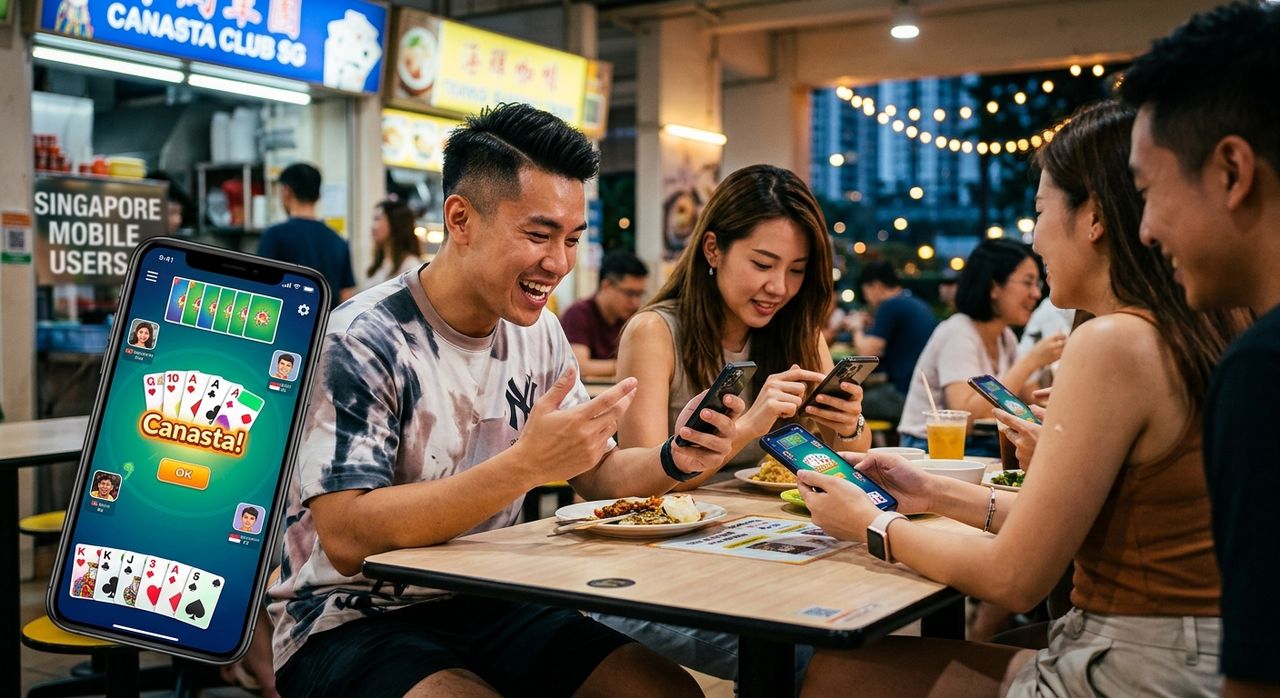
Something is shifting across Singapore's MRT carriages. Where commuters once defaulted to scrolling through social feeds or catching short videos, more screens are now showing card games. Specifically Canasta. A game that predates smartphones by about half a century is finding new life on them, and the reasons it is catching on here have everything to do with how Singaporeans actually spend their time in transit.
Key Points
- Canasta is gaining traction among Singapore mobile users who want deeper engagement than casual puzzle games offer
- Long MRT journeys and phone store queues create a natural window for multi-round card games
- Hand and Foot, a Canasta variant played across several rounds with multiple decks, fits longer sessions well
- The game runs entirely in a phone browser with no app download required
- New players who read the rules before their first game find the learning curve drops significantly
How a Classic Card Game Found a Modern Audience
Canasta has roots going back to Montevideo, Uruguay, in the late 1940s. It spread rapidly across the Americas and into Europe through the 1950s. At its peak, the history of Canasta shows it briefly outpaced Bridge as the most-played card game in the United States. Then television arrived, attention fragmented, and card games retreated to family gatherings and retirement community centres.
The mobile era has quietly reversed some of that retreat. Casual games on phones have always performed well. But something different is happening with Canasta. It is not a short game. It involves real strategy, spans multiple rounds, and rewards sustained attention. For a city where commutes regularly run 40 to 60 minutes each way, that structure turns out to be a feature, not a flaw.
Long Rides and Longer Queues: Why the Timing Works for Singapore
Singapore's public transport system is one of the most efficient in the world. But efficient does not always mean fast. The MRT system connects the island end-to-end, and cross-island journeys regularly run 40 to 60 minutes. Add walking time, line transfers, and platform waits, and a commute from Woodlands to Changi or from Bukit Panjang to Raffles Place can eat a significant stretch of the day.
Beyond commutes, Singapore's phone upgrade culture creates another kind of wait. Visiting a telco store to collect a pre-ordered device, sitting through a SIM transfer, or queuing outside a retail outlet at Funan or Jurong Point can take 30 to 45 minutes without warning. That idle time is a daily fixture for a lot of people here. And card games fill it better than most alternatives.
Here is what makes Canasta particularly suited to Singapore's commute and queue culture:
- Sessions scale to the time available, so a round left mid-game picks up exactly where it paused when you sit back down
- No audio cues are needed, which matters in crowded carriages and busy retail environments where earphones are not always practical
- Below-ground coverage gaps are irrelevant once a game has loaded, since Canasta does not need a constant internet connection mid-round
- Mental engagement is steady rather than frantic, which matches the pace of a commute far better than a fast-reflex action game
- Progress accumulates across rounds, so pausing at your stop does not feel like quitting or losing ground
Hand and Foot: The Variant Built for Longer Sessions
Within the Canasta family, different variants suit different windows. Classic Canasta can wrap up in a single 30-minute sitting. But hand and foot canasta is structured differently. It uses five or six standard decks shuffled together. Each player receives two separate piles of cards: a Hand, played first, and a Foot, which only comes into play once the Hand runs out.
This format stretches naturally across an entire commute or a long retail queue. A full session in Hand and Foot can span 60 to 90 minutes across multiple scored rounds. Each round has a clear ending point that makes pausing feel natural rather than abrupt. You finish a round, check the score, and the break before the next hand lines up exactly with arriving at your station or getting called to the service counter.
The deeper card pool also means more decisions per turn. Drawing from the deck, building melds, managing wildcards, and tracking what your opponent is laying down creates a sustained mental task. That kind of engagement is genuinely more satisfying to return to after a two-minute distraction than a social feed that has moved on without you.
Reading Up Before You Play Saves Frustration Later
Canasta is not difficult to learn, but a handful of mechanics catch new players off guard if they skip over them. Wildcards, specifically jokers and 2s, are powerful but limited. You can use them inside melds, but a canasta built entirely from seven cards of the same rank with no wildcards scores significantly higher than one padded with substitutes. Understanding that distinction early shapes strategy from the very first hand.
There is also the minimum meld requirement to be aware of. To lay down cards for the first time in a round, your initial meld must meet a minimum point threshold. That threshold rises as your cumulative score climbs across rounds. It creates real tension in the early turns of each game and rewards patience over rushing into melds too early.
Players picking up the game for the first time through their phone browser find the fastest path in is to work through canasta rules before jumping straight into a game. Five minutes reading is enough to understand the structure. The rest comes from playing.
How the Main Canasta Variants Stack Up for Mobile Play
Finding the Right Fit for Your Commute Length
| Variant | Decks Used | Typical Duration | Best Suited For |
|---|---|---|---|
| Classic Canasta | 2 decks | 30 to 45 minutes | Short MRT hops or lunch breaks |
| Hand and Foot | 5 to 6 decks | 60 to 90 minutes | Cross-island commutes and retail queues |
| Samba | 3 decks | 45 to 60 minutes | Players who want sequence-building added in |
| Brazilian Canasta | 2 decks | 30 to 50 minutes | Players who prefer stricter wildcard limits |
What Your Opening Session Actually Feels Like
Players new to Canasta often describe the first round as a slow build. You are sitting on your hand, watching the discard pile grow, and waiting for the right moment to lay down an initial meld that meets the minimum point threshold. That cautious opening is intentional. Once the melds start coming out on both sides, the pace picks up noticeably.
The discard pile in Canasta is not passive. It becomes one of the most contested objects in the game once both players are building toward canastas. Picking up the pile at the right moment can swing a round dramatically, and knowing when to block that pick-up becomes a key part of mid-game strategy.
Here is what most first-time players notice after a full session:
- Wildcards feel tempting to use early, but holding them for a natural canasta pays off more by the third or fourth round when the point margins widen
- Scoring at the end of each round gives a clear checkpoint before the next hand begins, and the visible gap sharpens focus without adding pressure
- Going out unexpectedly on your opponent closes a round fast and can swing the score in your favour before they have finished building their best meld
- The Foot pile arriving mid-session adds a second wind to the game, shifting priorities and creating new opportunities just when the first pile runs dry
A Card Game That Finally Fits the Phone Already in Your Hand
Singapore is a city of movement. People shift between districts for work, cross the island for family on weekends, and queue regularly for the devices that keep everything connected. That movement creates pockets of time every day, sometimes 20 minutes, sometimes over an hour, that deserve something more than passive scrolling.
Canasta fills those pockets in a way that shorter games cannot. It respects the time a commuter actually has. It does not punish a short interruption. It gives you something worth returning to after a station announcement or a called number pulls your attention away. And it fits entirely inside the browser on the phone commuters are already carrying, with no setup required beyond knowing how the game works.
The comeback is not nostalgia. It is a practical fit between an old game and a city that has finally given it the right conditions to be played.