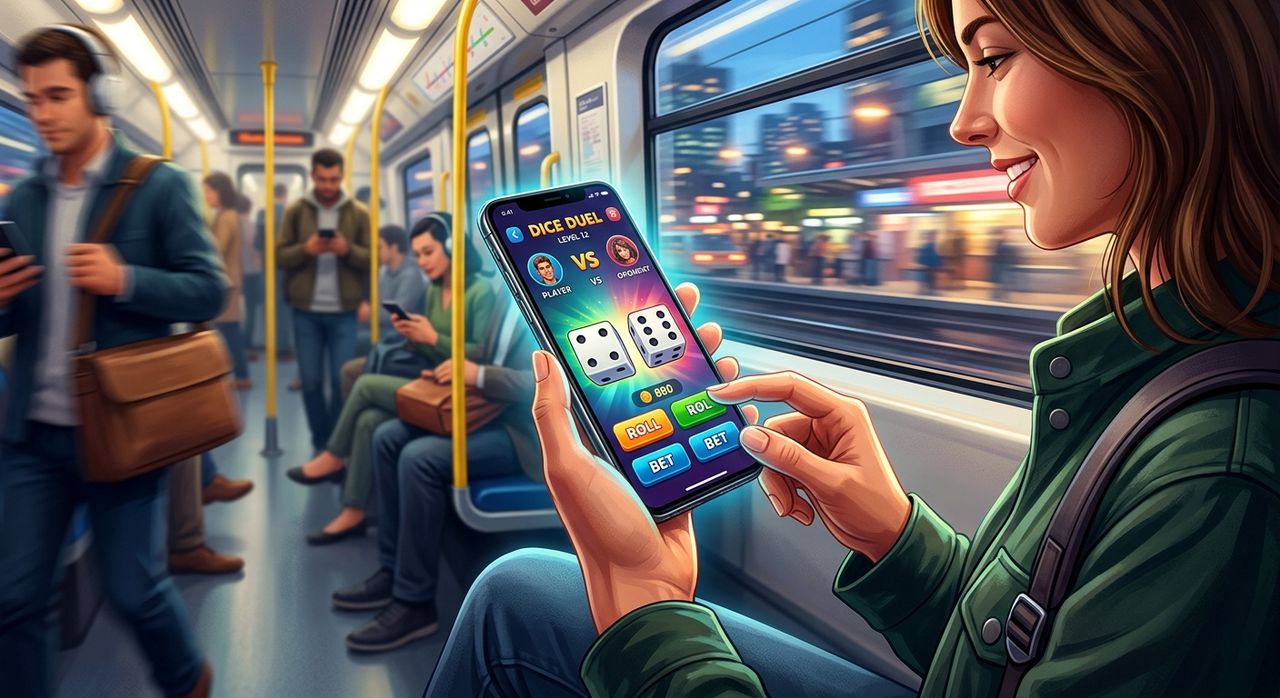
The doors slide shut at Jurong East. You have 38 minutes to Dhoby Ghaut, a phone at 60 percent battery, and the same five apps you always open staring back at you. Most people burn that time on content they forget before the next station. There is a better option sitting one browser tab away, and it costs nothing to try. Dice games built for the browser fit the commute session so naturally it feels like they were designed with the MRT in mind.
Browser dice games are the commuter's best-kept secret for filling dead travel time without draining storage or data.
- They run entirely in your mobile browser, no app store, no install, no permission requests required.
- A full gaming session barely registers on your data plan, making them safe to play even when you are stretching the last few hundred megabytes of your monthly allocation.
- Two formats suit different ride lengths: one for a short hop across a few stations, and a tactically deeper format for the full cross-island stretch.
Why Commute Time and Dice Games Are a Natural Fit
Gaming on public transport has its own unwritten rules. You might be standing in a packed carriage, or sitting with a stranger's shoulder pressed against yours. Your screen time comes in fragments. You pick up the phone at Clementi, put it away at Buona Vista, reach for it again at Commonwealth. That unpredictable rhythm destroys narrative games. It also makes anything requiring fast reflexes or precise taps almost unplayable.
Dice games sidestep all of that. Each turn is its own self-contained moment. You roll five dice, you read what you landed, you make one decision about where to score it. Then the game sits there patiently until you are ready again. No penalty for taking your time. No boss fight interrupted mid-sequence. No lives lost because a notification pulled your attention away for thirty seconds. The turn-based rhythm of dice scoring matches the start-and-stop nature of an MRT commute almost perfectly, as though both were designed by the same person with the same problem in mind.
The Browser Advantage That Changes Everything About Mobile Gaming
Here is what browser-based games do that most people underestimate: they load once, then they cache. That means if your signal dips between Bishan and Ang Mo Kio, the game is already in your browser's memory and keeps running without a hiccup. You are not streaming anything. You are not pulling assets from a remote server every few seconds. You are tapping a scorecard and rolling digital dice, and that is as lightweight as mobile gaming gets.
The bookmark function turns this into a real advantage. Add either game to your phone's home screen from Safari or Chrome and it appears as an icon, indistinguishable from an installed app. Tap it, and you are already at the dice screen. No loading screen with a cartoon mascot. No update reminder before you can play. No account creation form. For a rider who boards at 7.45am with five minutes of productive phone time before needing to stand up and hold a rail, that friction-free start is worth more than any feature comparison.
Triple Yahtzee: Built for the Long Haul Between Stations
Standard Yahtzee gives you a single scorecard with 13 categories. It plays out in a set number of rounds and wraps up in a session that suits a medium-length commute. That format is genuinely satisfying. But if your daily ride runs from Pasir Ris to Harbour Front, you have more time than a single card fills, and you need a format that stays interesting across the full journey.
That is where triple yahtzee changes what the game can be. Instead of one scoring grid, you are working across three simultaneous scorecards in a single session. Every score you enter on a given round gets multiplied based on which column you place it in. The first column scores at face value. The second doubles your points. The third triples them. That sounds manageable until you are staring at a full house on your third roll and trying to decide whether to bank it now in the safe column, or hold off in hopes of rolling another one to place in the tripling column later.
That decision layer transforms the format into something with real strategic depth. You are not just filling boxes to finish a card. You are managing three separate progressions at once, constantly weighing short-term security against long-term payoff. Players who know standard Yahtzee will feel at home immediately. The categories are familiar, the rolling mechanics are identical. But the three-column structure keeps producing new situations throughout the game, which is exactly what you need for a commute that runs longer than 25 minutes.
Yahtzee itself has a long and well-documented history as a classic dice format, as its recorded origins show, with roots going back to the early 1950s. The triple variant builds on that foundation without reinventing it, which is part of why it feels immediately intuitive even on a first session.
Yatzy: The Nordic Cousin That Feels Familiar but Different
Not every dice player arrived at the game through the American version. A significant number of players discovered this style of scoring through the Scandinavian variant, which shares the same core structure but diverges in ways that actually matter at the scorecard level. If you already play one format well and want something that feels fresh without starting from scratch, this is the one to reach for.
The yatzy game uses the same three-roll-per-turn structure and five dice, but the scoring columns differ from the American version in meaningful ways. The upper section bonus threshold works on a different calculation, which changes how aggressively you need to chase sixes and fives in the early rounds of the game. The chance row behaves slightly differently too. Neither change is dramatic, but together they shift your mental model just enough that you find yourself pausing and recalculating in moments where you would normally act on autopilot.
That small friction is the good kind. It keeps the brain genuinely engaged rather than going through the motions of a format you have memorised. For a commuter who plays standard Yahtzee regularly and finds themselves predicting the game's outcomes too easily, the Nordic variant delivers that novelty without the cost of learning something entirely new. The Scandinavian roots of the game give it a slightly different lineage, though both versions converged on remarkably similar structures independently, which is why swapping between them feels natural rather than jarring.
How the Two Formats Compare for Commute Use
Choosing between these two formats comes down to ride length and familiarity with the base game. Both are browser-based, both load fast, and both work on a mobile screen without needing to switch to landscape mode. The differences sit in session depth and scoring structure.
Triple Yahtzee vs. Yatzy: Key Differences for Commuters
| Feature | Triple Yahtzee | Yatzy |
|---|---|---|
| Scorecards per Session | Three simultaneous columns | One scorecard |
| Multiplier System | 1x, 2x, and 3x columns | Flat scoring, no multiplier |
| Ideal Ride Length | 30 minutes or more | 15 to 25 minutes |
| Upper Bonus Calculation | Standard Yahtzee threshold | Nordic variant threshold |
| Best For | Players who want deeper strategy | Players who want a fresh variation |
| Data Usage | Minimal, browser-cached | Minimal, browser-cached |
Getting More Out of Fragmented Screen Time on the Go
One mental shift that helps with commute gaming is letting go of the need to finish a session in one ride. Both formats keep your progress in the tab. Leave the game mid-scorecard at Outram Park, and it is still there when you pull out your phone on the evening return trip. Some players build on a morning position across three separate commute segments across the day, treating the whole thing as one extended session with enforced breaks built in. Those breaks, as it turns out, often help. Coming back to a half-filled scorecard with fresh eyes sometimes reveals a strategy you missed the first time.
Portrait mode also matters more than people expect. Both games are designed to sit comfortably on a vertical screen, which is better for train use because it is less conspicuous and easier to manage one-handed when you are holding a rail with the other. You do not need to spread your elbows wide or flip the phone sideways. The scorecard fits the vertical screen cleanly, and the dice roll from a single tap.
Battery usage is also negligible for browser-based dice games. There is no GPU rendering 3D animations. There is no background audio looping. A full game session of either format will cost you one or two percent of battery at most. That is a fair trade for 30 to 40 minutes of genuine engagement rather than passive scrolling that leaves you feeling like you wasted the commute.
Your Stop Is Your Save Point
The MRT and bus network in Singapore gives commuters something that people in cars do not get: permission to look at a screen without guilt. That time is real, even when it comes in five-minute chunks between stops. Browser dice games are shaped, whether by design or coincidence, to fit exactly into that rhythm. A short hop gets you two or three complete turns. A longer cross-island stretch might get you halfway through a fully scored game, ready to pick up tomorrow morning from the same seat.
Bookmark both formats now, before your next commute, so the decision is already made when you board. If you have a longer ride, the three-column format gives you enough tactical depth to stay genuinely interested all the way to the last stop. If you are hopping across two or three stations, the single-card Nordic version wraps up more neatly. Either way, the app store stays closed, your data meter barely moves, and you get off the train having actually used your brain rather than having handed it to an algorithm for the duration of the ride.
Sometimes the best gaming session of the week is the one that finds you. The train doors close, the phone comes out, and 35 minutes later you arrive somewhere better than you left. That is the commute session. These dice games fit it as well as anything you will find.