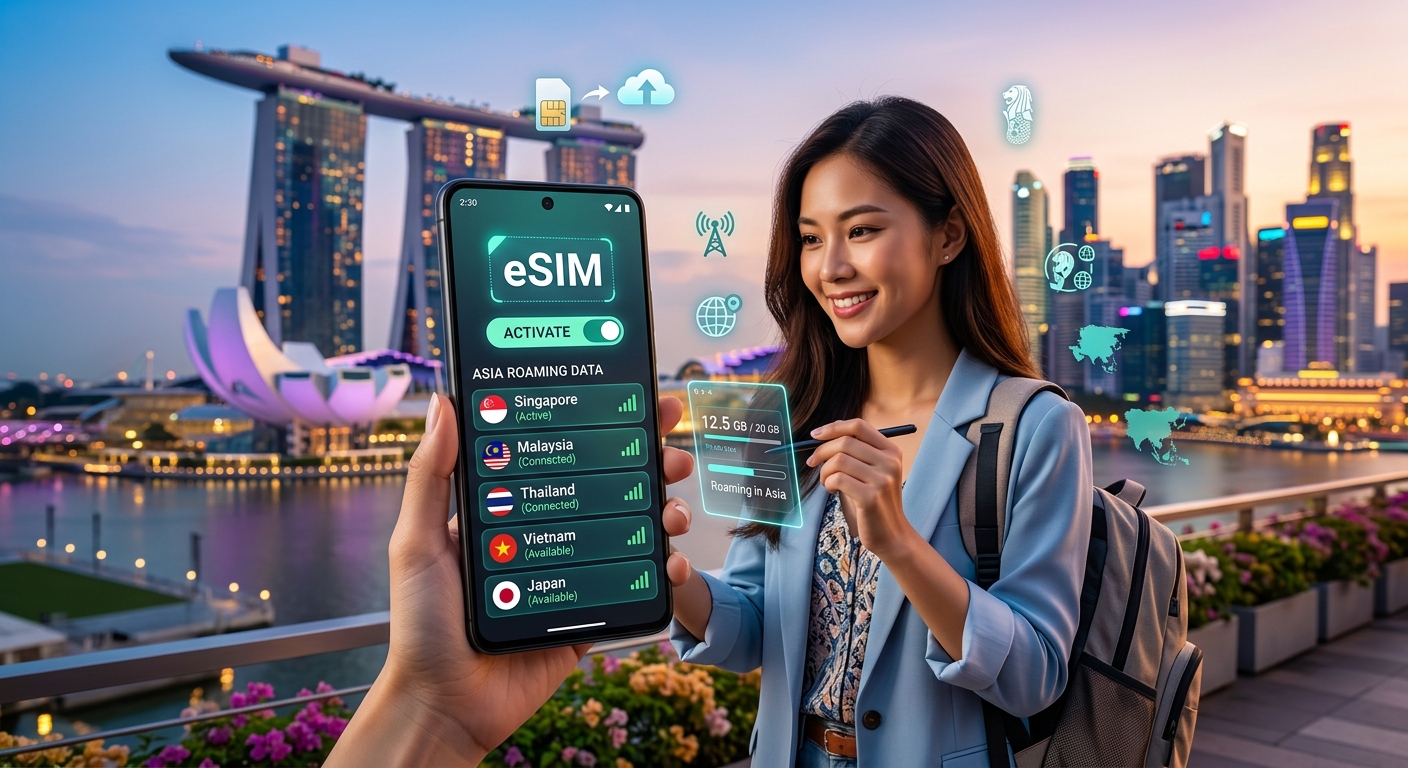
Your physical SIM card has been quietly doing its job since the day you unboxed your phone. It works. But if you travel across Asia regularly, or if you want the flexibility of running two numbers on one device without carrying two phones, the eSIM opens up a much cleaner approach to connectivity. For Singapore users, setting one up is less complicated than most people expect. And once eSIM is running on your device, your options for staying connected across the region expand significantly.
eSIM in Singapore: What You Need to Know Before You Start
- All three major Singapore carriers, Singtel, StarHub, and M1, support eSIM activation through their apps or websites, with no store visit required for most standard plans.
- Your phone must be eSIM-compatible and free from carrier restrictions; newer iPhones, Samsung Galaxy S-series, and Google Pixel models generally qualify.
- Once eSIM is active on your device, adding a regional data plan for Asia travel takes minutes, with no physical SIM swap needed.
What an eSIM Actually Is and Why It Changes Things
An eSIM is a SIM built directly into your phone's circuit board. The "e" stands for embedded. Unlike a standard nano-SIM, it cannot be physically removed or swapped out. Instead, you download a carrier profile onto it over the internet. Built on eSIM technical specifications maintained by the GSMA, the protocol works identically whether you activate a plan in Singapore or scan a QR code from a travel provider anywhere in Asia.
That global standardisation matters in practice. It means a Singapore carrier eSIM profile and a third-party travel eSIM both download through the same secure mechanism on your device. The handshake between phone and carrier happens over a protected data channel. No plastic card. No courier. No waiting.
For Singapore users, eSIM has moved from niche feature to mainstream option. Singtel, StarHub, and M1 all support it. The list of compatible devices grows with every flagship release cycle.
Checking Whether Your Phone Is eSIM-Ready
Before anything else, confirm your phone can handle eSIM. Most devices released in the last three to four years support it, though coverage varies across price brackets.
Apple's iPhone XS and every model that followed support eSIM. iPhone 14 and 15 models sold in Singapore are dual SIM, meaning one physical slot and one eSIM slot, both active at the same time. Samsung's Galaxy S21 and newer, along with the Z Fold and Z Flip series, all support eSIM. Google Pixel devices from the Pixel 3 onwards also qualify. Budget and mid-range phones are catching up, but not every model in those categories includes eSIM yet.
The fastest way to check is through your phone settings. On iPhone, look under Settings, then Mobile Data, then Add eSIM. On Android, the path varies by manufacturer but typically sits under Settings, Connections, SIM Manager, or a similar label. If the option is greyed out or absent, your device may not support eSIM, or it could be carrier-locked.
Carrier-locked phones are the one common snag. If you bought your device on a subsidised contract from a Singapore carrier and have not yet completed the lock period, the phone may only accept that carrier's SIM profile. Confirm your device's lock status with your current carrier before attempting to add an eSIM from a different provider.
Activating eSIM Through Singtel, StarHub, and M1
Each Singapore carrier has its own activation flow, but the underlying structure is consistent across all three. You will need a stable Wi-Fi connection, an active account with the carrier, and a compatible device. For most standard postpaid activations, no in-store visit is required.
Carrier eSIM Activation at a Glance
| Carrier | Activation Platform | Requirements | How You Receive the Profile |
|---|---|---|---|
| Singtel | MySingtel app or Singtel website | Active account, compatible device, Wi-Fi | QR code via email or in-app |
| StarHub | MyStarHub app or StarHub website | Active account, compatible device, Wi-Fi | QR code via email or SMS |
| M1 | M1 app or M1 website | Active account, compatible device, Wi-Fi | QR code via email |
Once you have the QR code from your carrier, the rest is handled on your phone. On iPhone, go to Settings, Mobile Data, Add eSIM, and choose to scan a QR code. Point the camera at the code, confirm the profile download when prompted, and the eSIM line activates within a few minutes. Android devices follow a similar path through the SIM manager settings, though the exact labels differ between manufacturers.
If scanning does not work, most carriers also provide a manual activation code you can type in directly. This is a useful fallback when the QR code is printed small, or when harsh lighting is making it hard for your camera to read the code cleanly.
Running Two Lines on One Device
One of the more practical benefits of eSIM in Singapore is the ability to keep two lines active on one phone without any extra hardware. This suits people managing a personal and work number on the same device, or travellers who want a local Singapore number active at all times alongside a separate data plan.
Singapore phones sold in the last two years typically support dual SIM configurations where one line runs on a physical SIM and the other on eSIM. Some newer flagship models support two eSIM profiles active simultaneously. You can configure each line independently for calls, SMS, and mobile data through your phone settings. A common approach among Singapore users is to keep the main local number handling calls and texts, then route data through whichever plan offers the better rate for the current situation.
What Happens to Your Connectivity When You Travel Across Asia
This is where the eSIM setup really earns its place for Singapore travellers. The region is large and carrier coverage is fragmented. Moving between Malaysia, Thailand, Japan, South Korea, and Indonesia means dealing with different networks and very different cost structures on each one.
Standard international roaming through your Singapore carrier can handle short trips reasonably well. But daily data caps and per-megabyte pricing on some roaming plans make them a less cost-effective choice for longer journeys or frequent regional travel.
Many Singapore travellers load a dedicated travel eSIM plan instead. The logic is practical. Your Singapore number stays active on your local SIM or Singapore eSIM profile, so calls and SMS still come through normally. A separate regional eSIM profile handles data, connecting to local networks in each country without roaming surcharges. You set it all up before you leave. No airport SIM kiosk queue needed at Changi or at the other end.
For those ready to compare options, Asia eSIM data plans are laid out side by side, showing country coverage and data volumes in one place. That kind of structured overview is genuinely useful when your trip spans multiple countries and you need to confirm a single plan covers your full itinerary.
Key Points to Verify Before Buying a Travel eSIM
Not every travel eSIM plan suits every trip. Before committing to one, take a moment to check the following:
- Country coverage: Some plans cover five countries; others cover fifteen or more across Asia. Match the plan to your actual travel schedule, not just your intended destinations.
- Data cap versus speed throttling: Some plans advertise unlimited data but drop connection speeds after a daily threshold. Confirm whether you are getting a hard cap or a soft throttle.
- Validity window: Plans typically run from seven to thirty days. A plan that activates on purchase and expires in seven days is poorly matched to a trip that starts a week after you buy it.
- Activation trigger: Some plans activate on purchase; others activate on first use in a destination country. First-use plans give you more control over the validity window, especially on multi-stop itineraries.
Most reputable travel eSIM providers send the QR code to your email within minutes of purchase. You can install the profile before you leave Singapore, set it to activate when you land, and arrive at your destination already connected.
Managing eSIM Profiles After You Return to Singapore
When you get home, your travel eSIM plan typically expires on its own based on the validity period or the data consumed. You can then delete the profile from your device through your phone's SIM management settings. No call to the provider required.
Some providers let you top up or extend an existing eSIM profile rather than downloading a fresh one each trip. If you travel to the same regional markets regularly, that reuse option removes a few steps from the process each time you depart.
Your local Singapore carrier eSIM profile, if that is how you have your Singapore number set up, is entirely separate from any travel profiles you load. They coexist on the device without interfering with each other. Deleting a travel profile at the end of a trip does not affect your Singapore line in any way.
Your Phone, Your Network, the Whole Region
Getting eSIM running on a Singapore phone is a one-time setup that changes how you think about mobile connectivity. Your Singapore number stays with you regardless of where you are. Your data routing can shift to whatever plan makes practical sense for the country you are in. And the whole arrangement is managed through a few taps in settings, with no physical SIM to track, store, or misplace at the bottom of a travel bag.
Singapore's carriers are held to strict interoperability requirements by Singapore's telecoms regulator, which ensures that locally activated eSIM profiles align with global standards. That regulatory foundation underpins the reliability of the whole system, both when you set up eSIM here and when you add a travel plan from a provider overseas.
For anyone who crosses borders between Singapore and the rest of Asia even a few times a year, the combination of a solid local eSIM setup and a well-matched regional travel plan delivers genuine value. The initial setup takes under half an hour. The savings on roaming charges accumulate meaningfully over time. And arriving somewhere already connected, without a second thought about SIM cards, is the kind of convenience that becomes difficult to give up once you have had it.