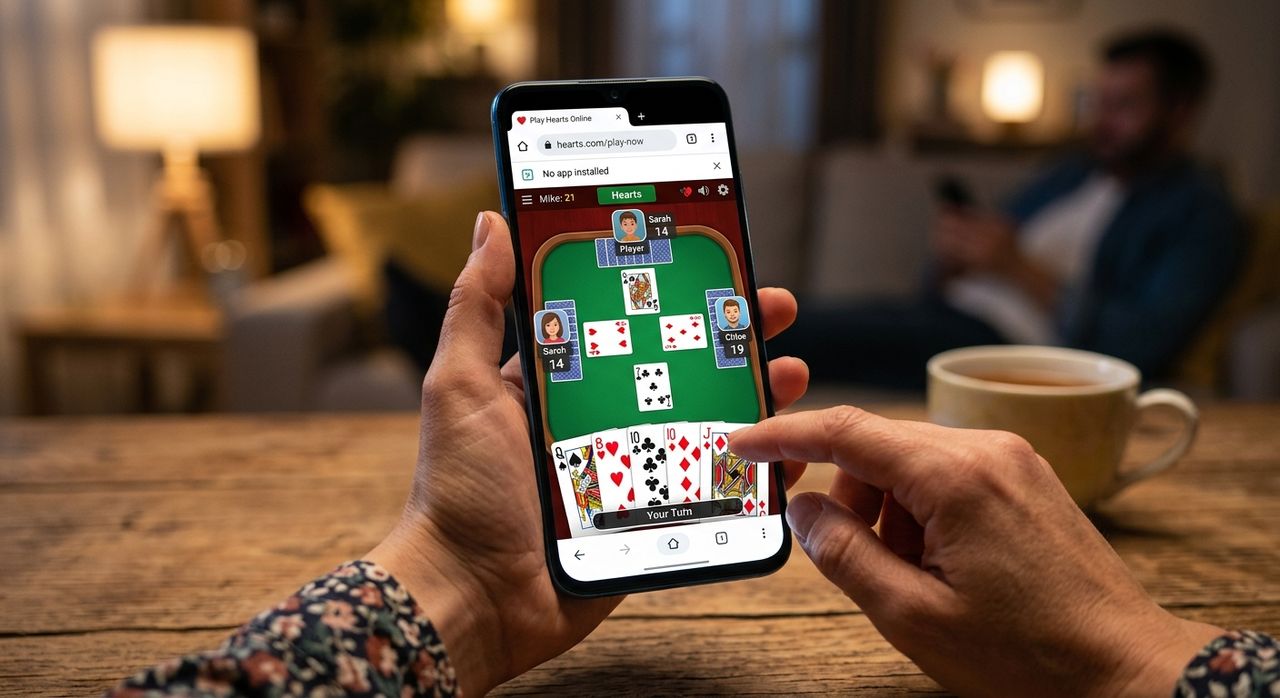
Your phone already has everything it needs to run a full Hearts game. No download required. No storage eaten up. No permissions to approve. Just open a browser tab, and you are in a full game within seconds. That is not a compromise. That is good mobile design doing exactly what it should.
A full Hearts game, live in your browser before an app could even finish installing
The Short Version
- Hearts runs completely in a mobile browser, with zero installs and zero storage used
- A tap on the rules page gives you a full refresher before your first live game, in the same browser session
- Two players on separate phones can join the same table in real time, no app needed by either person
- Modern browser games load as fast as native apps on any current Android or iOS device
- Touch controls, responsive layout, and live scoring all work natively, with nothing to configure
Why Hearts Works So Well on a Phone Screen
Hearts is a trick-taking card game built for four players. The goal is straightforward: avoid collecting hearts and, above all, dodge the Queen of Spades. Every round, you pass three cards to a neighbor, then play out thirteen tricks. Points are bad. The player with the fewest at the end wins.
That compact structure makes it ideal for mobile. Each decision fits in the palm of your hand. You tap a card, watch the trick resolve, and move on. There is no long inventory to manage, no extended tutorial to survive. The game loop is tight, tactile, and completely at home on a touchscreen.
Hearts has deep roots. The game traces its origins to the 1880s, and it found a new generation of fans through the version bundled with Windows for decades. Now it lives comfortably in the browser, and the mobile experience is genuinely polished rather than a stripped-down afterthought.
Getting Up to Speed Before Your First Live Game
If you have not played Hearts in a while, or if you are picking it up for the first time, do not skip the rules page. One of the best parts of a well-built browser experience is that onboarding is instant. You tap a link, read a clear page, and you understand the game before you touch a single card.
That is exactly how reading through hearts rules works in practice. It is a clean, mobile-friendly reference that covers card values, the shooting the moon mechanic, passing sequences, and scoring. You read it on your phone, in the same browser session, then start playing. No separate app. No account setup. No friction between learning and doing.
That kind of instant onboarding is what separates thoughtfully built browser experiences from clunky ones. Good mobile UX puts the information you need right in front of you and then gets out of the way. A rules page that loads cleanly, reads well on a small screen, and connects directly to gameplay is a small thing done right.
How the Browser Competes With Native Apps on the Metrics That Matter
The argument that native apps beat browser experiences used to hold water. It is a much weaker argument now. Modern browsers on Android and iOS handle JavaScript at near-native speed. They render smooth animations. They support touch gestures, orientation changes, and full-screen mode. The gap between a well-built web experience and a store-downloaded app has narrowed dramatically.
The concept behind this shift has been building for years. The principles behind a progressive web app have held up: browser-delivered apps can be fast, reliable, and capable of real-time interaction without the overhead of a full install cycle. For a card game like Hearts, the browser version wins on several fronts:
- Load time is instant. There is no install step, no update prompt on launch, and no waiting for a splash screen to clear.
- Storage stays untouched. Your phone's memory does not shrink to accommodate yet another icon on your home screen.
- Compatibility is universal. The same URL works on your friend's Android, your partner's iPhone, and a tablet at home.
- Updates are seamless. When the developer improves the game, you get the new version the next time you open the tab, automatically.
- Privacy stays cleaner. No app permissions, no push notification requests, no background data running while you are not playing.
Playing Against Real People on Separate Phones, Right Now
Solo play against a computer opponent has its place. But Hearts is fundamentally a social game. The tension of not knowing who holds the Queen of Spades, the satisfaction of watching someone else get stuck with it, the mind games of the passing phase: all of that only fully exists when you are playing against other humans.
The browser version delivers that. Through hearts multiplayer, two players on completely separate phones can sit at the same virtual table and race through the same deal in real time, without either person needing to install a thing. One player starts a room. The other joins from their own browser. The game syncs live. Tricks resolve instantly. Scores update as they happen.
From a smartphone buyer's perspective, this matters as a concrete test case. The question you should be asking about any phone you consider buying is: does this device handle live browser-based apps smoothly, without lag or dropped frames? For any current mid-range or flagship device, the answer is yes. Hearts multiplayer in a browser is not a stress test. It is a well-optimized experience that runs cleanly on modest hardware.
The Case Against Letting Downloaded Games Pile Up
Think about the apps you downloaded once, played twice, and then never opened again. They sit on your phone, taking space, sometimes running background processes, occasionally asking you to update them. Each one is a small overhead you did not sign up for.
Browser-based games break that pattern entirely. You visit when you want to play. You close the tab when you are done. Nothing lingers. Your home screen stays organized. Your battery and storage stay intact. And if you decide you never want to play again, there is nothing to uninstall.
This is not a niche preference. A growing number of users, particularly on Android, are actively choosing to bookmark web apps rather than install native ones. The behavior makes sense. If the browser experience is good enough, and for Hearts it clearly is, then the install step becomes a cost with no benefit attached to it.
What the First Session Actually Looks and Feels Like
Here is what the experience looks like on a current smartphone, described plainly:
- The page loads in under two seconds on a standard 4G or Wi-Fi connection, with no waiting for assets to cache.
- The card layout scales cleanly to your screen size, whether you are on a compact 6-inch display or a larger phablet.
- Touch targets on the cards are large enough to tap accurately without needing to zoom in or use a stylus.
- The game tracks your score across all rounds without requiring you to create an account.
- Switching from a solo game to a live room takes a single tap, with no menu-diving or hidden settings to navigate.
None of those things are extraordinary. They are simply good design executed consistently. But consistent execution across a mobile browser game is rarer than it should be, and this implementation lands on the right side of that bar every time.
When a Browser Tab Outperforms an Installed App
The old mental model treated browser games as lesser versions of real apps. That model no longer reflects how mobile devices actually work in 2024 and beyond. A Hearts game that loads before an app could finish installing, teaches you the rules in the same session, connects you to another human player on a completely different phone in real time, and leaves no trace when you close the tab, that is not a workaround. That is a better product for how most people use their phones.
For smartphone buyers who think carefully about which experiences are worth installing versus which ones work perfectly in a browser, Hearts is a clear example of the latter category. You get the full game. You get the social layer. You get it immediately, on any device, with any friend who has a phone and a browser. Your home screen stays clean and your storage stays yours.
Sometimes the best app is the one you never had to install at all.