After eight years of rumours, Apple's first folding phone stops being a rumour in the early hours of Thursday morning, Singapore time. Here is the sober version of what to expect from the device most people are calling the iPhone Fold, why it almost certainly will not be called that, and which of the leaked specifications actually hold up.
The short version
- Apple's Surprise and Shine keynote runs at 1:00am on Thursday 10 September, Singapore time. It is the first keynote led by John Ternus, who replaced Tim Cook as CEO on 1 September.
- The foldable is a book-style device, not a clamshell. A 5.5-inch cover screen opens into roughly 7.8 inches.
- Most reporting points to the name iPhone Ultra, not iPhone Fold or iPhone Flip.
- Expect Touch ID instead of Face ID, and no telephoto camera. Both are space compromises.
- Analyst estimates cluster between 2,000 and 2,500 US dollars, roughly S$2,550 to S$3,200.
- Supply is the real story. Reports describe production measured in hundreds of units a day as recently as late August.
Why it is probably not called the iPhone Fold
The two names in circulation, iPhone Fold and iPhone Flip, are both likely wrong, and the second one is wrong in a more interesting way. "Flip" describes a clamshell: a normal-sized phone that folds in half to become pocketable, like Samsung's Galaxy Z Flip or the Motorola Razr. That is not what Apple has built. Every credible description points to a book-style foldable, where a usable outer phone opens into a small tablet.
"Fold" is closer, but Samsung has spent seven years attaching that word to the Galaxy Z Fold line, and Apple has never been fond of naming a first-generation product after a competitor's category label. The name that keeps surfacing in supply-chain reporting is iPhone Ultra, which also conveniently sidesteps the number problem: there is no iPhone 18 this year, only the 18 Pro and 18 Pro Max, with the standard models pushed to spring 2027.
The hardware, as far as anyone can tell
The specification sheet below is assembled from supply-chain reporting rather than anything Apple has confirmed. Treat it as a well-sourced draft, not a fact.
| Component | What is expected |
|---|---|
| Inner display | 7.76in OLED, 2713 x 1920, 120Hz ProMotion, roughly 4:3 |
| Cover display | 5.49in OLED, 2088 x 1422 |
| Thickness | About 4.5mm open, 9 to 9.5mm closed |
| Frame | Titanium for load-bearing parts, aluminium for heat and weight |
| Hinge | Amorphous alloy, widely described as liquid metal |
| Chip | A20 Pro on TSMC 2nm, with vapour-chamber cooling |
| Memory | 12GB RAM; 256GB, 512GB and 1TB storage |
| Rear cameras | Two 48MP sensors, wide and ultrawide. No telephoto |
| Front cameras | 24MP on the cover, a second camera on the inner panel |
| Biometrics | Touch ID in the side button. No Face ID |
| Connectivity | Apple C2 modem, eSIM only, no physical SIM tray |
The crease is the whole pitch
Every book-style foldable ever sold has a visible crease down the middle of the inner screen. Apple's reported target is to make it effectively invisible: under 0.15mm deep, with a bend angle below 2.5 degrees. Reaching that has taken a stack of separate decisions, each of which costs money. Samsung Display is understood to be supplying a custom panel with touch sensors integrated into the stack rather than layered on top, which alone cuts around 19 percent of the thickness. Underneath sits ultra-thin glass, a reformulated optically clear adhesive, and a structural glass mid-frame.
Whether it works is the single thing worth watching during the keynote, because it is the one claim Apple cannot make with a press release. Somebody will hold the thing at an angle under stage lighting within hours.
The two things it gives up
There is no Face ID. The TrueDepth array needs depth that a 4.5mm half simply does not have, so authentication moves to a Touch ID power button of the kind already used across the iPad line. In practice this is a downgrade for anyone used to unlocking without touching anything, and an upgrade for anyone who wears gloves or unlocks a phone lying flat on a desk.
There is also no telephoto lens. Two 48MP sensors, wide and ultrawide, and nothing beyond that. For a device expected to cost more than two thousand dollars, shipping a camera system less capable than the iPhone 17 Pro Max is the most awkward compromise in the package, and it is the one Apple will have to talk around on stage.
How it compares with the foldables already on sale
Apple is not entering an empty category. These are the current book-style flagships, with figures taken from our own specification database rather than from Apple's expected claims.
| Foldable iPhone (expected) | Galaxy Z Fold8 | Pixel 11 Pro Fold | |
|---|---|---|---|
| Inner screen | 7.76in, 120Hz | 7.6in LTPO AMOLED 2X, 120Hz | 8.0in LTPO OLED, 120Hz |
| Open thickness | ~4.5mm | 4.9mm | 5.0mm |
| Chipset | A20 Pro (2nm) | Snapdragon 8 Elite (3nm) | Tensor G6 (3nm) |
| Memory | 12GB RAM | 12GB RAM | 16GB RAM |
| Battery | Disputed, see below | 4800 mAh, 45W wired | 4806 mAh, 30W wired |
| Telephoto | No | No | Yes, 10.8MP |
Two things stand out. Apple would take the thinness crown, but only by fractions of a millimetre over hardware that has been on sale for months. And on the inner display Apple would actually be the smallest of the three. The differentiator was never meant to be size. It is the aspect ratio: a 4:3 inner panel and a cover screen wide enough to type on with one hand, against Samsung's taller, narrower approach. Apple is building a phone that opens into a tablet. Samsung built a tablet that folds into a phone.
What is still genuinely contested
Not every leak agrees, and the disagreements are worth naming rather than smoothing over.
Battery capacity. Reporting collected by MacRumors points to a dual-cell pack in the 5,400 to 5,800 mAh range, which would be the largest ever fitted to an iPhone. Other leaks put the combined figure at 4,883 mAh, which would be merely competitive. These are not close enough to average, and the gap is large enough to change how the device is reviewed.
MagSafe. Bloomberg's Mark Gurman has said the foldable supports it. Several hands-on leak reports of dummy units describe no visible magnet ring. Both cannot be right.
The price. Estimates have never converged. UBS has suggested 1,800 to 2,000 dollars. JPMorgan has landed near 2,000. Ming-Chi Kuo and Bloomberg both say 2,000 to 2,500. Fubon says 2,400, IDC around 2,500 on average, and TrendForce puts the entry point at 2,099 to 2,299 with top configurations above 3,000. The honest summary is that nobody outside Apple knows, and the spread between the low and high estimate is larger than the entire price of a mid-range phone.
Supply is the story nobody wants to lead with
The most consequential reporting of the past fortnight has nothing to do with specifications. The Weibo leaker Instant Digital claims Apple was producing only a few hundred units a day in late August, held back by quality control on hinge and display durability, against an annual order of roughly 10 million units. The same report suggests mainland China may not be in the first wave at all, and describes a staggered country-by-country rollout closer to the Vision Pro launch in 2024 than to a normal iPhone release.
Gurman disputes the severity, saying he would be very surprised if the foldable did not ship alongside the 18 Pro or within weeks of it. Both can be partly true: a device can launch on schedule and still be nearly impossible to buy. Singapore is not usually in Apple's first launch wave for a supply-limited product, and local pricing here includes GST.
Also expected tonight
The iPhone 18 Pro and 18 Pro Max, with a variable-aperture main camera, a smaller Dynamic Island and a reported 5,567 mAh cell in the Max. Apple Watch Series 12 and Ultra 4, both modest updates. AirPods 5 with a new H3 chip. Possibly a 7-inch home hub, a refreshed Apple TV 4K and a HomePod mini. Pre-orders are expected on Saturday 12 September, with general availability on Friday 18 September.
What to actually watch for
Three moments will tell you whether this is a landmark or an expensive first draft. Whether Apple demonstrates the crease head-on or keeps the inner screen at flattering angles. Whether it gives a durability number for the hinge, or declines to. And whether the on-sale date is stated plainly or hedged with a vague "later this year", which would confirm the supply reporting more clearly than any leak.
If those three land well, Apple has arrived seven years late to a category and made everything already in it look provisional. If they do not, this is a 2,500-dollar development kit for the second-generation model expected in 2027, the iPhone's twentieth anniversary year. Either way, it is the most significant change to the iPhone since the iPhone X, and the first keynote of a new chief executive is an unusually exposed place to attempt it.
Compare current foldables and flagships in our database: Galaxy Z Fold8 Ultra, Pixel 11 Pro Fold, every Apple iPhone, or browse 12GB RAM phones and 1TB storage phones.
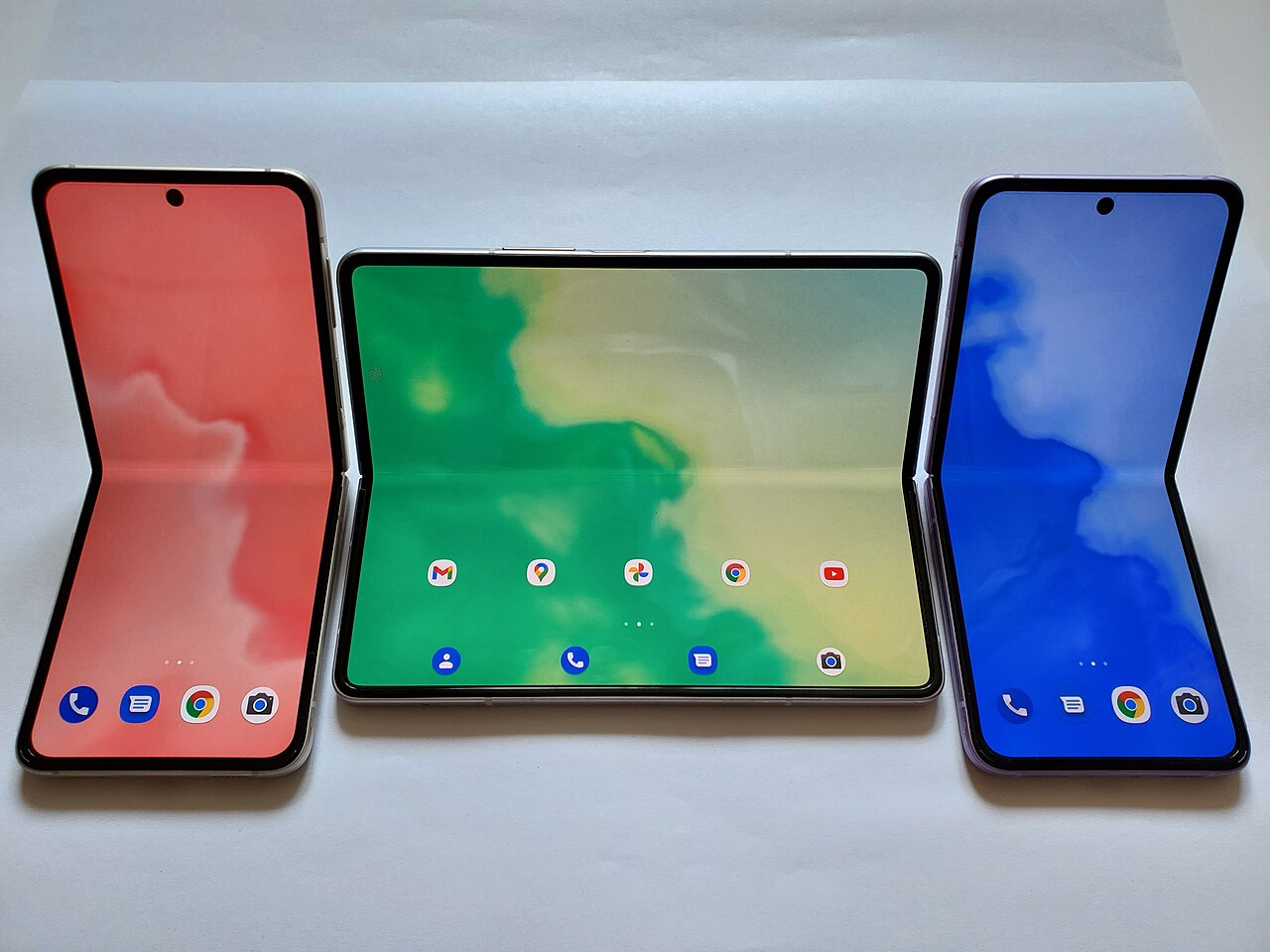
Every specification above is based on supply-chain reporting and analyst estimates, not on confirmed Apple information, and may change once the device is announced. Reporting drawn from MacRumors, Bloomberg, TrendForce, UBS, JPMorgan, IDC and Ming-Chi Kuo. Photo: Galaxy Z series by Ka Kit Pang, licensed under CC BY 3.0. It shows existing Samsung foldables, not Apple's unreleased device.